
Dental Case Presentation: How to Communicate Treatment So Patients Actually Understand It
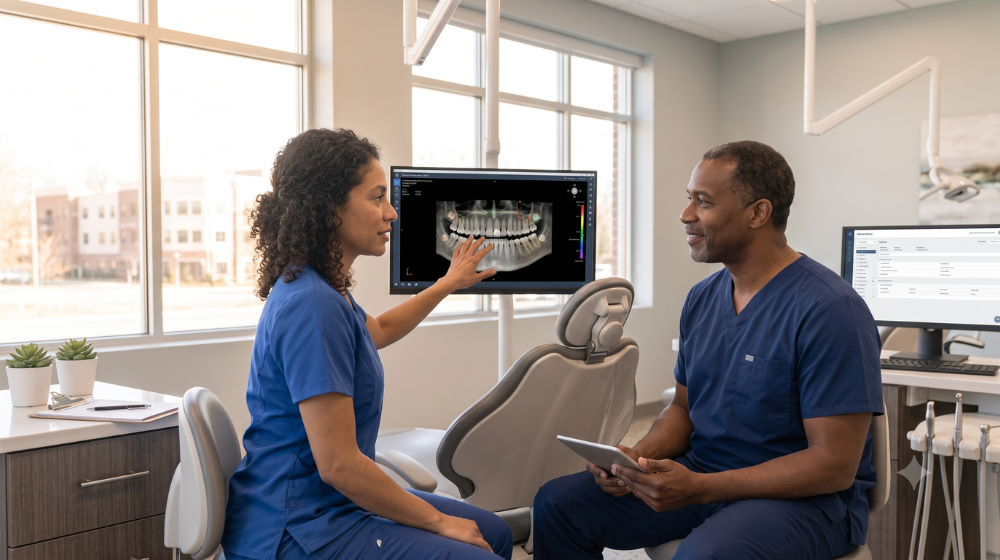
Most patients don't decline treatment because they don't care about their teeth. They decline because the conversation left them confused, anxious, or unsure whether the cost was worth it. That gap — between clinical recommendation and patient understanding — is a communication problem, not a clinical one. This guide breaks down the craft of dental case presentation: how to sequence the conversation, when to introduce cost, how to use visuals without overwhelming, and what to say when a patient stalls.
Frame the Conversation Before You Present a Single Finding
The biggest mistake in case presentation isn't what gets said — it's when. Jumping straight from exam findings to treatment recommendations skips the step that makes everything else land: context.
Before you present, establish what the patient already knows and what they care about. A patient who came in for sensitivity is oriented differently than one who came in for a routine cleaning and had no idea anything was wrong. Your opening framing needs to meet them where they are.
A simple bridge works well here: "I want to walk you through what I found today and why it matters, and then we'll talk through your options." That single sentence signals that this is a conversation, not a verdict. It also reduces the ambient anxiety that causes patients to shut down mid-presentation.
Sequence Findings the Way a Story Moves — Not the Way a Chart Reads
Clinical notes are organized for documentation. Case presentations need to be organized for understanding. Those are different structures.
Start with what the patient can relate to — their symptom, their concern, the reason they came in. Then connect your findings to that experience. "The sensitivity you mentioned is consistent with what I'm seeing here — this area of wear is exposing the dentin, which is what's triggering that sharp response." Now the clinical finding has a narrative home.
From there, move from the most urgent issue to the least. Patients can absorb a prioritized list; they often can't absorb a comprehensive findings dump. If there are five things to address, tell them that — and be clear which one needs to happen first and why.
Sequencing also means controlling the pacing. Don't present everything and then ask if they have questions. Pause at each major item. Let the patient respond. That exchange is where you learn whether they've followed you, and it keeps the conversation from feeling like a lecture.
Use Visuals to Confirm, Not to Convince
Intraoral cameras and digital X-rays are powerful — when used correctly. The risk is using them as a persuasion tool rather than an educational one. Patients can sense when they're being shown something to be sold.
The better frame: visuals confirm what you're already explaining in plain language. Describe the fracture, then show it. Explain where the decay is tracking, then point to it on the image. The visual becomes evidence that validates your explanation, not a shock tactic designed to close a sale.
This also applies to how you talk during the visual review. Avoid narrating findings in clinical language while pointing at an image the patient doesn't have the training to interpret. Say what you see in plain terms first: "This dark area here is decay that's worked its way underneath the existing filling." Then show them.
Some patients are highly visual and will engage immediately. Others will glaze over the moment an image appears. Read which type you're dealing with and adjust accordingly.
Introduce Cost Before the Patient Has to Ask
Few moments in a case presentation create more friction than the patient having to ask, "So what does this cost?" It puts them in an uncomfortable position — one that feels like they're being difficult — and it often means the financial conversation happens when anxiety is already elevated from hearing about the treatment itself.
The better approach: bring cost into the conversation naturally, before there's an awkward silence where it should have been.
A straightforward transition works: "Before we look at scheduling, I want to make sure you have a clear picture of what this looks like financially." That moves the conversation to cost on your terms, at a point where you can frame it with context — what insurance typically covers, what the out-of-pocket portion looks like, and what payment options exist if the patient needs flexibility.
This doesn't require the dentist to handle the full financial conversation. In many practices, the handoff to a treatment coordinator happens here. What matters is that the transition is clean and the patient doesn't feel passed off — they feel guided.
Talking About Cost Without Apologizing for It
The language around cost matters. Apologetic framing — "I know this is a lot," "unfortunately this can be expensive" — signals that the treatment's value doesn't justify the price. It creates hesitation rather than resolving it.
Confident, neutral framing does the opposite. "Here's what this looks like financially" is a statement of fact. It opens a conversation. It doesn't ask the patient for permission to charge them.
When presenting costs, give the patient something to anchor to. Out-of-pocket cost after insurance is more useful than the full fee. Monthly payment amounts (when a financing option exists) are more useful than a lump sum. The goal is to make the number feel manageable and contextualized — not minimized, but clear.
One useful technique: connect cost to consequence. "If we address this now, we're looking at a crown. If we wait until the fracture extends further, we may be looking at a root canal and a crown — or extraction and an implant." Patients can weigh a number better when they understand what the alternative costs.
Handling "Let Me Think About It" Without Pressure
When a patient says "let me think about it," the instinct is often to press — to ask what the hesitation is, or to offer another layer of persuasion. That instinct usually backfires.
"Let me think about it" almost always means one of three things: the patient didn't understand something, the patient is worried about cost, or the patient isn't sure the treatment is necessary. Each requires a different response, and you can't give the right one without knowing which you're dealing with.
The most productive response is also the simplest: "Of course — before you go, is there anything I can clarify that would help you decide?" That question invites them to surface the real concern without feeling interrogated.
Three things that help when a patient defers:
-
Send a written summary of what was recommended and why — patients often review this at home when they can think without time pressure
-
Make it easy to call back with questions, and tell them so explicitly
-
Set a clear timeframe: "This is something we'd want to address within the next few months" gives them a mental deadline without creating pressure in the room
What you're not trying to do is change their mind on the spot. You're trying to make sure the decision they make at home is fully informed.
What Gets in the Way of a Good Presentation (Even When You Know the Material)
Dentists who struggle with case presentation usually aren't struggling with clinical knowledge. The issue is almost always one of these: rushing through the conversation because the schedule is tight, using clinical language without realizing the patient has stopped following, or losing the thread when a patient asks a question mid-presentation.
Time pressure is the hardest constraint to solve at the chair. Some practices build dedicated case presentation time into their scheduling templates — a deliberate block where the dentist isn't managing chair time, just the conversation. Others use a dedicated treatment coordinator room so the handoff to financial conversation happens in a different environment, which psychologically resets the patient.
The language problem is easier to address with deliberate practice. Recording case presentations (with patient consent) and reviewing them for jargon is one of the most effective calibration tools available. What sounds like plain language to a clinician often doesn't land that way.
Better Presentation Starts With Better Systems Behind It
Even the most skilled communicator runs into friction when the systems supporting the presentation aren't working. Treatment notes that are incomplete, financial estimates that haven't been run, insurance breakdowns that aren't ready — each of these interrupts the flow of a case presentation at exactly the wrong moment.
Practices that consistently deliver clear, confident case presentations typically have one thing in common: the information the dentist and coordinator need is organized and accessible before the patient conversation starts. Curve Dental builds treatment plan documentation and financial workflows into the same platform as clinical charting, so the handoff from exam to presentation doesn't require chasing down data across multiple systems.
The Conversation Is the Treatment Plan's First Step
A case presentation isn't an obstacle between diagnosis and scheduling. It's the moment a patient decides whether to trust you with their care — and whether they understand enough to say yes with confidence. Getting the sequencing right, introducing cost proactively, using visuals to clarify rather than impress, and knowing what to say when a patient hesitates: these are learnable skills. They're also worth investing in, because every presentation that lands well makes every subsequent conversation with that patient easier.
If you're evaluating how your practice supports this process — from charting to financial workflows — the scheduling and treatment planning tools that connect those dots are worth a close look.
*This content was partially generated by artificial intelligence. It may contain errors or inaccuracies, and should not be relied upon as a substitute for professional advice.

Curve Dental
The team behind Curve Dental serves up content across all things dentistry to help you make informed decisions for your practice(s).