
Is Your Dental System Holding Back Ambient AI—and Costing You Performance?
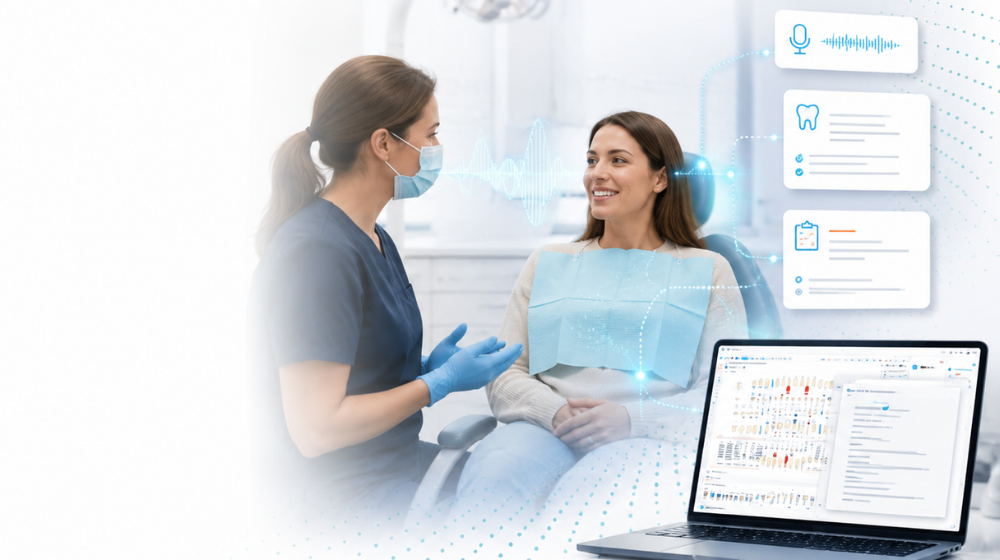
Many dental practices are investing in AI—but not seeing meaningful results.
The issue isn’t adoption. It’s that most systems can’t support AI at the level modern workflows require.
And that gap is already showing up in documentation quality, claim performance, and team workload.
Ambient AI in dentistry is one of the clearest indicators of whether a system can support modern workflows. When it works, it transforms documentation, improves accuracy, and strengthens patient communication. When it falls short, the consequences extend far beyond efficiency.
Ambient Intelligence for Efficient, Precise Documentation
AI tools assist the dental team but do not replace the friendly faces patients rely on. In truth, AI is designed to give the dental team more time with the person, not less.
When that intelligence is native to the system, it doesn’t interrupt the workflow—it becomes the workflow. Patients notice the efficiency—and the extra moments it creates for meaningful communication.
For example, platforms like Curve are designed to solve the bottleneck created when manual restorative and perio charting require two people. With Curve’s native Perio+—through its Curve Care+ AI suite—a solo provider can capture pocket depths via voice in real-time, maintaining clinical standards even when the practice is running lean.
Notes+, another feature under the Curve Care+ AI suite, is ambient intelligence that transforms chairside conversations into structured SOAP notes as the visit unfolds. This prevents "Documentation Drift," where notes written hours later lose the specificity needed for insurance support, leading to the dreaded claim denial loop.
This is where ambient AI moves beyond convenience—and begins to impact financial performance.
Building Trust Through Person-Centered Transparency
Trust is the foundation of any good relationship. Patients may fear a "black box" diagnosis where a computer replaces clinical judgment. When AI is implemented thoughtfully, it does the opposite—it makes clinical reasoning more visible.
For example, a dentist might use AI-powered software, such as Pearl's Second Opinion®, integrated directly into the Curve platform. The AI highlights potential areas of concern—like a small spot of decay—that the human eye might miss. The dentist then reviews the analysis to confirm the diagnosis.
In the moment of sitting side by side and reviewing the evidence together, the dentist helps the patient move from a passive recipient to an active partner.
The Intentional AI Imperative: Co-Pilot, Not Autopilot
As AI becomes more embedded in clinical workflows, a new concern is emerging—over-reliance. Some fear that AI could replace critical thinking. In reality, the opposite is true.
AI raises the standard for clinical judgment.
The system may identify a pattern or highlight an area of concern—but the provider must interpret it within the full context of the patient’s history, risk profile, and goals.
This is why Curve emphasizes Managed Clinical Precision—intelligence that supports decisions, not replaces them.
When AI is used as a co-pilot, not an autopilot, it strengthens both confidence and clinical outcomes.
Where Ambient AI Breaks Down in Most Dental Systems
Ambient AI is a direct test of whether your practice management system can support modern clinical workflows.
Ambient AI requires:
-
Real-time documentation
-
Continuous data flow
-
Integrated clinical workflows
If your system introduces delays, fragmentation, or manual steps, ambient AI cannot operate effectively.
Instead, teams experience:
-
Incomplete documentation
-
Interrupted clinical flow
-
Increased reliance on manual correction
This is where performance begins to break down.
Where Performance Becomes a Financial Issue
When documentation is incomplete, incorrect, or delayed, the impact shows up immediately in financial loss:
-
Rework
-
Delayed reimbursement
Ambient AI, when functioning properly, eliminates this gap by capturing structured, complete notes at the point of care.
The Cost of Staying Where You Are
Practices operating without effective AI workflows often see:
-
Higher claim denial rates due to incomplete documentation
-
Increased staff burnout from administrative workload
These aren’t isolated inefficiencies. They compound across every patient visit, every claim, and every day that your system stays the same.
Why Native Systems Like Curve Change the Equation
The difference between incremental improvement and measurable performance comes down to architecture.
In a unified, cloud-based system:
-
Documentation is captured in real time
-
Clinical insights appear in context
-
Data flows continuously across workflows
This allows ambient AI to function as intended—not as a disconnected tool, but as part of daily operations.
For most practices, that difference comes down to the system they’re running today—not the tools they’ve added to it.
This is where the conversation shifts—from what AI promises to what your system actually enables.
Does Your PMS Support Ambient AI?
At this stage, the question isn’t whether Ambient AI can improve your practice.
You’ve seen what’s possible:
-
Real-time documentation
-
More precise clinical records
-
Stronger patient understanding
-
Reduced administrative burden
The real question is whether your current system can support it—or whether it’s the reason you’re not seeing results.
Because when your system can’t support Ambient AI, the gaps show up quickly:
-
Notes are completed after the visit
-
Clinical details are missing
-
Claims are delayed or denied
-
Teams are working after hours to finish what should already be done
Ambient AI is a clear signal of where dentistry is headed and one of the clearest indicators of whether a practice is operating on a modern system—or working around its limitations.
If your team is still completing notes after hours, managing rework from denied claims, or working across disconnected systems, the issue isn’t effort—it’s infrastructure.
Evaluate Your Next Steps
If you’re actively assessing whether your current system can support modern AI workflows, start here.
→ See Curve in Action
Schedule a personalized demo to evaluate whether your current system is limiting your performance—and what changing it could unlock.
→ Understand the Transition Process
Explore The Anti-Anxiety Playbook for Dental Software Implementation: Why Confidence Is the Real ROI to see how practices move to Curve with minimal disruption and full support.
→ Validate the Industry Shift
Review the latest findings from the 2026 HealthStream Ventures Dental Industry Report to understand why cloud-native, AI-powered systems are becoming the standard.
→ Assess Long-Term Fit
Read Finding Your ”Goldilocks" Zone: Why Software Scale Matters in 2026 to determine whether your current system aligns with your growth and profitability goals.

Curve Dental
The team behind Curve Dental serves up content across all things dentistry to help you make informed decisions for your practice(s).