
The Shift from Records to Revenue: Why Charting Matters in 2026
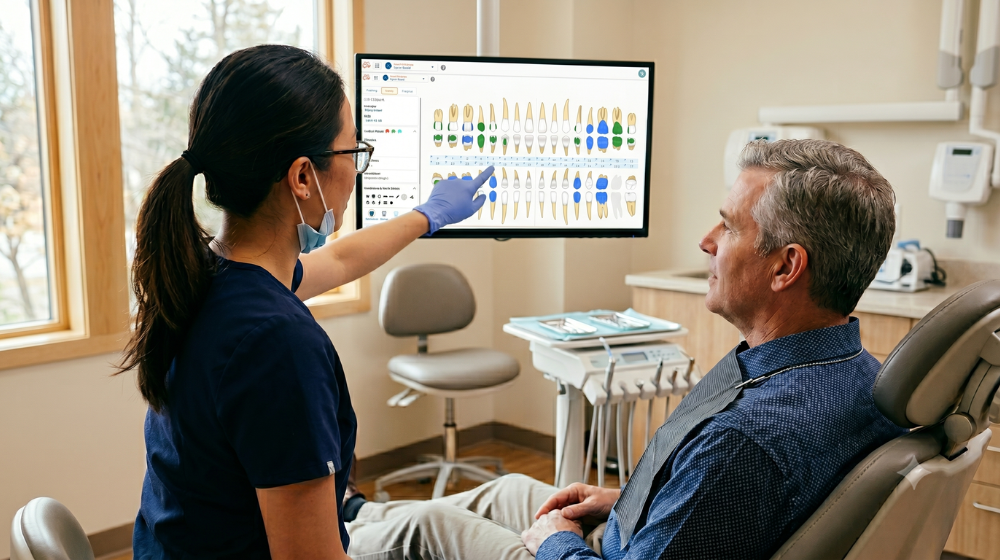
Dental charting software has quietly become one of the most consequential tools in a practice's operational stack — not just for documentation, but for growth.
Paper-based charting was always a liability waiting to surface. Illegible notes, missing periodontal readings, inconsistent notation across providers — these weren't just workflow inconveniences. They created real exposure in audits, insurance disputes, and patient care decisions. Modern cloud-based dental software replaces that fragility with structured, searchable, and consistently formatted clinical records that the entire team can access in real time.
Accurate documentation is one of the strongest legal protections a practice has. Digital charting can vastly improve clinical documentation accuracy when compared to paper records.
But accuracy is only part of the picture. Today's dental charting software does something paper never could: it turns clinical data into a patient communication tool. When patients can see their periodontal measurements, existing restorations, and recommended treatment mapped visually in front of them, case acceptance improves. That's a direct line from documentation quality to revenue.
The link between how charts are built and maintained and practice profitability is more direct than most practices realize. Errors in charting lead to claim denials, delayed reimbursements, and compliance risk — all of which quietly erode collections.
What follows explores how modern charting fits into a unified platform designed to support the full patient journey, starting with the fundamentals every assistant needs to know.
Dental Charting for Beginners: A Guide for Modern Assistants
Dental charting for beginners doesn't have to feel overwhelming — the right digital workflow makes the learning curve shorter than most new assistants expect.
Modern dental charting software is built around a standardized visual framework that any trained team member can navigate consistently. At its core, that framework includes a tooth map (a graphical representation of all 32 teeth), condition indicators, and a periodontal grid for recording pocket depths, bleeding points, and recession measurements. Understanding how these elements connect is the foundation of accurate, team-wide documentation.
Standardized digital notation significantly reduces the risk of human error tied to illegible handwriting and manual entry — a critical advantage when multiple team members are documenting in the same patient record.
Here's what new assistants should focus on first:
-
Learn the tooth map layout. Teeth are numbered 1–32 (universal numbering system). Knowing this cold means faster navigation during live exams.
-
Understand condition codes. Decay, existing restorations, and pathology each have standardized symbols. Consistent use keeps the entire team on the same page.
-
Practice moving between the perio grid and tooth chart. Most platforms let you toggle quickly — explore how to build perio charting accuracy before you're in a live exam.
-
Enter data in real time. Waiting until after the exam to chart from memory introduces errors. Type or voice-record findings as the provider calls them out.
Real-time entry is especially manageable in cloud-based dental software with voice-enabled charting — a feature covered in depth when we look at how visual tools shape the patient experience next.
The Diagnostic Power of 3D Graphical Charting
Upgrading to 3D graphical charting in your digital dental charting software isn't just a visual enhancement — it's a clinical communication shift that directly influences patient decisions.
Traditional 2D charting captures data, but it rarely communicates urgency. A flat diagram of tooth numbering and surface codes means something to a clinician. To a patient sitting in the chair, it's almost meaningless. They can't see the decay undermining a molar or the bone loss progressing along a root. Without that visual context, it's easy for patients to defer treatment.
When patients see a realistic, three-dimensional model of their own oral health — not a generic illustration, but a representation of their mouth — the psychology shifts. The problem becomes real. Deferred treatment starts to feel like a risk they're choosing to accept, not just a recommendation they can ignore.
Visual clarity is one of the most underrated drivers of treatment acceptance in dental practice operations.
This is where modern charting tools close the gap between clinical diagnosis and patient understanding. Practices using 3D graphical interfaces consistently see stronger case acceptance because the conversation changes — from "the doctor recommends" to "here's what you're looking at."
That same visual foundation becomes even more powerful when applied to periodontal tracking, which is where the next opportunity for operational efficiency lives.
Boosting Hygiene Productivity with Integrated Perio Tools
Integrated periodontal charting tools directly reduce the time hygienists spend on data entry — and that time savings translates into measurable practice growth.
Manual probe recording is one of the quietest productivity drains in a dental practice. A hygienist calling out six measurements per tooth, waiting for someone to type or write each number, then repeating that process across a full mouth exam adds significant non-clinical time to every appointment. Multiply that across a full schedule and the inefficiency compounds fast.
Automation changes that workflow entirely. When periodontal data captures in real time — synced directly into the patient record — hygienists can focus on clinical assessment rather than dictation. They identify disease progression faster because the system flags changes automatically, without manual cross-referencing. This is where modern perio charting workflows create a genuine clinical advantage, not just an administrative one.
Side-by-side historical comparisons add another layer of value. Showing a patient their pocket depths from six months ago alongside today's measurements makes disease progression tangible. That visual context is one of the most effective patient motivators available — it moves conversations from abstract risk to concrete change.
The productivity gains are significant. According to Dental Economics, practices implementing integrated periodontal charting software see an average 15–20% increase in hygiene department productivity.
When that productivity gain is paired with dental treatment planning software that connects perio findings directly to restorative recommendations, the hygiene department becomes a stronger driver of overall practice revenue — not just a standalone appointment type.
Reducing Overhead with Voice-Activated and Online Charting
Modern dental charting programs are eliminating two of the biggest operational drains in a practice: excess staffing overhead and expensive on-site infrastructure.
Voice-activated charting is one of the clearest examples of workflow automation paying off immediately. A single clinician can record findings hands-free — without a dedicated dental assistant in the room. That's a meaningful reduction in per-appointment overhead, especially for solo or small group practices where staffing costs are already tight.
The hands-free model also addresses a clinical concern that often goes unspoken: cross-contamination risk. When clinicians aren't toggling between a patient's mouth and a keyboard, the opportunity for surface contamination drops significantly. It's a practical infection control improvement that supports both patient safety and regulatory compliance.
Cloud-native dental charting extends these gains further. A cloud-based dental software platform gives clinicians and administrators access to complete patient records from any location, which matters most for multi-location practices or hybrid schedules. There's no waiting for a VPN connection or worrying about whether the server room is running properly.
Eliminating on-site servers removes a hidden but consistent cost: hardware maintenance, IT support contracts, and the risk of data loss during equipment failure. A server-free platform shifts that responsibility to a secure cloud infrastructure, freeing up budget and mental bandwidth for patient care.
As modern dental practice operations grow more complex, the software holding it all together needs to keep pace — which raises a natural question about what platforms are actually leading that shift.
Navigating the Dental Software Market
The dental software market is shifting fast — and practices still running legacy desktop systems are feeling that gap widen every year. The transition to online dental charting and cloud-native platforms isn't a trend anymore. It's the new operational baseline.
The core shift: unified platforms are replacing fragmented toolsets. For years, practices pieced together separate solutions for charting, scheduling, billing, and imaging. That approach creates data silos, slows down workflows, and adds unnecessary IT overhead. Modern cloud-native platforms consolidate those functions into a single, scalable system — which is exactly why all-in-one platforms are increasingly favored over legacy alternatives.
AI is accelerating this shift further. Automated X-ray analysis, clinical decision support, and AI-powered documentation tools are now embedded features in leading platforms — not add-ons. Practices that understand how AI fits into clinical workflows are already seeing gains in diagnostic accuracy and chair-time efficiency.
For practices weighing free open-source options against enterprise solutions, the tradeoffs are real. Free tools from platforms can work for very small or single-provider practices with limited budgets. However, they typically lack the revenue cycle management integration, centralized reporting, and compliance infrastructure that growing practices require.
The right choice depends on where your practice is headed. If growth is the goal, the software needs to support it — and the full picture of what that means is worth examining closely.
The Bottom Line: What You Need to Know
Modern dental charting software isn't a digital filing cabinet — it's a core driver of practice growth, operational efficiency, and patient experience.
Here's what the evidence across this article makes clear:
-
Documentation accuracy improves significantly when practices move from paper-based or disconnected systems to cloud-based dental charting workflows. Fewer transcription errors mean fewer claim denials, cleaner records, and less time spent on corrections.
-
3D visuals and integrated perio tools directly influence case acceptance. When patients can see their clinical data clearly, treatment decisions become easier. Practices that use visual charting tools consistently see stronger patient engagement and faster treatment plan approvals.
-
Voice-activation and cloud access reduce real overhead. Server-free workflows eliminate expensive IT maintenance, and voice-activated charting reduces the need for a dedicated chairside assistant during every exam — cutting staffing costs without cutting care quality.
-
The right platform unifies clinical and operational data. Cloud-native platforms provide centralized clinical visibility across your entire practice, supporting predictable growth by connecting charting, scheduling, billing, and reporting in one place.
The dental software market is moving forward. Practices that invest in a unified platform built for modern dental practice operations won't just document more efficiently — they'll schedule smarter, collect faster, and grow with less friction at every level of the practice.
*This content was partially generated by artificial intelligence. It may contain errors or inaccuracies, and should not be relied upon as a substitute for professional advice.
Curve Dental
The team behind Curve Dental serves up content across all things dentistry to help you make informed decisions for your practice(s).