
OSHA Training for Dental Offices: What Your Team Actually Needs to Know
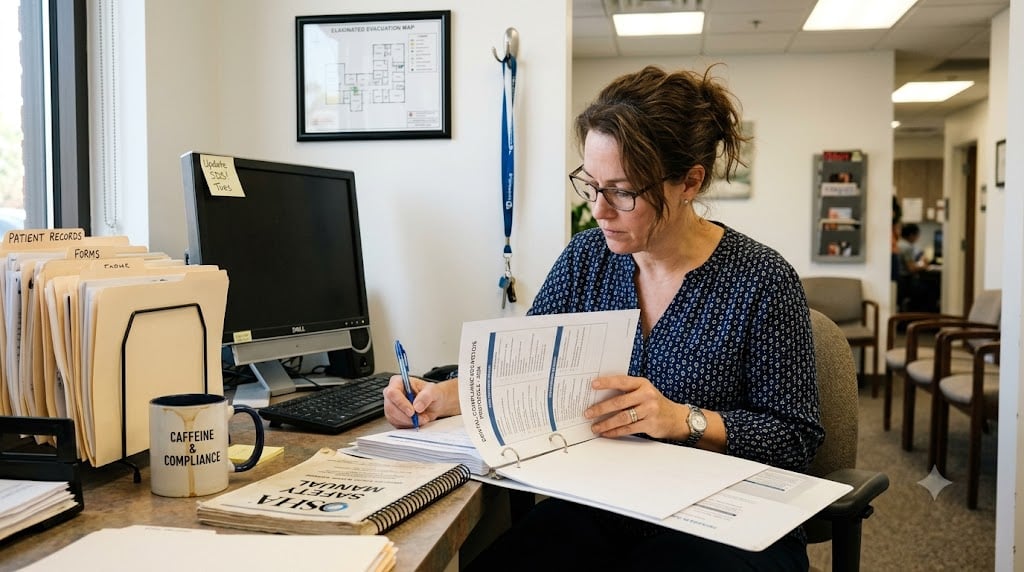
Compliance requirements have a way of feeling more complicated than they are. OSHA training for dental offices follows a clear structure — specific topics, defined audiences, and set timelines — and once you understand what's actually required, building a compliant training program is straightforward. This guide covers who needs training, what must be included, how often it has to happen, and how to document it properly.
Who Is Required to Complete OSHA Training
Every employee with potential occupational exposure to hazardous materials or bloodborne pathogens must receive OSHA training. In a dental office, that includes clinical staff across the board: dentists, hygienists, dental assistants, and anyone who handles instruments, manages sharps, or comes into contact with patient blood or saliva.
Front desk staff and billing coordinators are a more nuanced case. If their role involves no exposure risk — they never handle clinical materials, never enter operatories during treatment — some employers classify them as low or no exposure. That said, many dental offices train all employees on at minimum the Hazard Communication Standard, since staff in shared spaces can encounter chemical hazards. When in doubt, erring toward more training rather than less is the defensible position.
New employees must be trained before they begin work that involves exposure risk — not during orientation week, not after a few days on the floor.
What Topics OSHA Requires You to Cover
Two federal standards drive the bulk of OSHA training requirements for dental offices: the Bloodborne Pathogens Standard (29 CFR 1910.1030) and the Hazard Communication Standard (29 CFR 1910.1200). Each has specific content requirements.
Bloodborne Pathogens training must include:
-
An explanation of the Bloodborne Pathogens Standard and where to access it
-
Epidemiology and symptoms of bloodborne diseases
-
Routes of transmission
-
The practice's Exposure Control Plan — where it is, what it says, how employees can access it
-
Engineering and work practice controls, including sharps disposal and needle safety
-
Personal protective equipment (PPE): types, selection, use, removal, and disposal
-
How to handle an exposure incident, including what to do immediately and who to notify
-
Available post-exposure medical evaluation and follow-up
-
Hepatitis B vaccination — availability, benefits, and how to decline if an employee chooses to
Hazard Communication training must include:
-
An overview of the HazCom standard
- Location and use of the Safety Data Sheets (SDS) for all hazardous chemicals in the workplace
- How to read chemical labels and interpret hazard pictograms
- Specific hazards present in your office (disinfectants, impression materials, amalgam, etc.)
- Appropriate protective measures for each
Some offices also need to address the OSHA Ionizing Radiation Standard if staff operate dental X-ray equipment, though state dental board requirements often govern radiography training more directly. Check your state requirements separately.
How Often Training Has to Happen
Initial training happens before exposure risk begins. Annual retraining is required for all covered employees under the Bloodborne Pathogens Standard — every 12 months, no exceptions. This isn't a refresher you can skip if the team seems experienced. OSHA requires it regardless of tenure.
Retraining is also required when:
-
Your Exposure Control Plan is updated
- New tasks or procedures create different or additional exposure risks
- New equipment or controls are introduced that affect how staff manage exposure
Annual training doesn't have to be a half-day event. A well-structured session covering the required topics can run 60 to 90 minutes. What matters is content coverage and documentation, not duration.
The Exposure Control Plan Isn't Optional — and It's Not Just a Document
The Exposure Control Plan (ECP) is a foundational OSHA requirement. Every dental office with employees at risk of occupational exposure must have one, keep it current, and make it accessible to staff during their shift. "Accessible" means a physical copy in the office or an electronic version employees can reach without jumping through administrative hoops.
The ECP must be reviewed and updated at least annually, and whenever new procedures or roles change the exposure landscape. This annual review isn't just a formality — it's the kind of documentation OSHA will ask for during an inspection.
Training records must log: the date of training, the content covered or a summary, the names and job titles of attendees, and the name and qualifications of the trainer. These records must be maintained for three years.
Where Training Actually Falls Short in Most Offices
The most common compliance gaps aren't about what's being taught — they're about documentation, timing, and consistency. New hires start clinical rotations before training is completed. Annual sessions happen in month 14 instead of month 12. A staff change means the office is running on a trainer who isn't qualified.
OSHA requires that training be conducted by someone knowledgeable in the subject matter. That doesn't mean credentialed in a formal sense, but it does mean the trainer must be able to answer employee questions. Pre-recorded training modules can satisfy this requirement when paired with a mechanism for employees to ask questions — a live Q&A at the end, or a designated person available afterward.
State and local OSHA plans can add requirements beyond federal minimums. States with their own OSHA programs sometimes have more specific or more stringent rules. You can find a list of state OSHA plans on OSHA's site.
Building a Training Calendar That Stays Current
One of the simplest ways to stay compliant is to anchor training to a fixed month each year rather than tracking individual employee anniversaries. Most practices set a single annual training date for all clinical staff, then handle new hire training separately as employees join.
A basic compliance calendar for a dental office might look like this:
Annual (set month):
-
Full Bloodborne Pathogens and HazCom training session for all covered staff
- Exposure Control Plan review and update
- Confirm SDS binder or digital records are current
Upon hire:
-
Pre-exposure training before clinical duties begin
- Hepatitis B vaccination offer documented (accepted or declined in writing)
As needed:
-
Retraining when procedures, equipment, or the ECP changes
- Incident review training following any exposure event
Keeping Records Without Making It a Second Job
Training documentation doesn't require expensive software, though it does make the process easier. A simple spreadsheet with employee names, training dates, topics covered, and trainer information satisfies the core requirement. What it does require is discipline — records kept somewhere accessible, backed up, and retained for at least three years.
Exposure incident records follow a different timeline: they must be kept for the duration of employment plus 30 years, per OSHA's medical records rule. Separate that file from general training records and make sure the practice owner or office manager knows where it lives.
Curve Dental and similar practice management platforms can help organize the administrative side of running a dental office, but OSHA training records are typically maintained separately — in a dedicated HR folder, a compliance binder, or a document management system outside of clinical software.
How to Handle a Compliance Audit
OSHA inspections in dental offices can be triggered by a complaint, a reported exposure incident, or a programmed inspection in high-risk industries. When an inspector arrives, the first things they'll typically ask for are your Exposure Control Plan and training records.
Having those two things organized and immediately accessible is the single most important step you can take. Inspectors aren't trying to catch practices off guard — but gaps in documentation are the fastest path to a citation.
If you're unsure where you stand, OSHA's free On-Site Consultation Program offers confidential, no-penalty assessments for small businesses. It's a practical option for new practice owners who want an objective read before a real inspection occurs.
Getting OSHA Training Right From the Start
OSHA training for dental offices comes down to four things: training the right people, covering the required content, doing it on time, and keeping the records to prove it. None of those steps are technically difficult — but all of them require someone in the practice to own the process.
For new practice owners and office managers building compliance programs from scratch, start with your Exposure Control Plan, set your annual training date, and document every session from day one. That foundation makes everything else manageable.
If you're looking for additional guidance, OSHA's dental industry resources are a practical starting point.
This content was partially generated by artificial intelligence. It may contain errors or inaccuracies, and should not be relied upon as a substitute for professional advice.
Curve Dental
The team behind Curve Dental serves up content across all things dentistry to help you make informed decisions for your practice(s).