
The High Cost of the 'Learn as You Go' Training Model
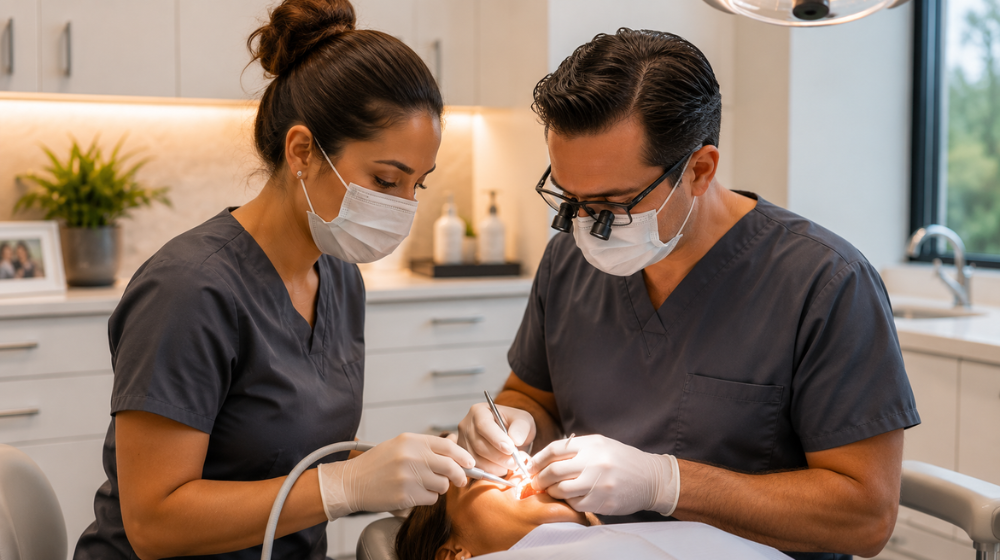
Running a dental practice means managing clinical excellence and business operations at the same time — and few things disrupt both faster than an undertrained team. Informal training doesn't just slow new hires down — it quietly drains practice revenue, staff confidence, and patient trust every single day.
Each open dental assistant position costs a practice approximately $10,000 in recruitment and training expenses. That number reflects recruiting costs, productivity gaps, and the operational drag of an undertrained team member finding their footing. Yet many practices still rely on shadowing and informal mentorship as a substitute for a structured dental assistant training program — and it shows.
The problem with "watch and learn" onboarding isn't just speed. It's inconsistency. When there's no curriculum guiding how procedures are explained, how treatment is presented, or how patients are reassured, every team member develops their own version of the job. That inconsistency creates uneven patient experiences that erode trust — and trust is exactly what drives scheduling, referrals, and long-term practice retention.
Staff confidence compounds the issue further. The average onboarding gap stretches five months before most dental employees feel fully capable in their roles. That's five months of hesitation during patient interactions, slower workflows, and preventable errors in dental practice operations. Structured training isn't overhead — it's infrastructure. And the next question is who, exactly, stands to gain the most from it.
Why Dental Assistants Are Your Secret Weapon for Treatment Acceptance
A well-trained dental assistant doesn't just support the dentist — they directly influence whether patients say yes to care.
That connection between dental assistant training and treatment acceptance is backed by real data. 91% of dental office managers report that trained dental assistants increase the likelihood of patient treatment plan acceptance. That's not a marginal difference — it's a significant driver of practice revenue.
The reason comes down to trust. When an assistant can explain a procedure clearly, anticipate a patient's concerns, and reinforce what the dentist just recommended, the patient feels informed rather than pressured. That psychological shift matters enormously at the point of case presentation.
Trained assistants turn clinical conversations into revenue.
Here are the specific behaviors that drive higher case acceptance:
-
Reinforcing treatment value by echoing the dentist's recommendations in plain language after the exam
-
Addressing common objections around cost, discomfort, or timing with confident, empathetic responses
-
Building rapport during setup and takedown time, when patients are most likely to open up about hesitations
-
Walking patients through financial options calmly, reducing the anxiety that kills acceptance at the front desk
Practices that invest in reducing overhead often focus on staffing costs — but undertrained assistants carry a hidden cost far greater than any salary line item: lost case acceptance.
Once your assistants are confidently driving treatment acceptance, the next efficiency opportunity is in how the entire clinical flow is structured — starting with the rhythm of how appointments run.
Mastering the 2-2-2 Rule and Four-Handed Efficiency
Structured staffing training around the 2-2-2 rule gives dental teams a repeatable framework that improves patient flow and protects the dentist's physical output across a full day of care.
The concept is straightforward. 2 minutes of prep means the assistant has the room set, instruments ready, and the patient oriented before the dentist walks in. 2 minutes of procedure focus means the assistant is fully anticipating the next instrument, managing moisture control, and tracking patient comfort — no hesitation, no searching. 2 minutes of post-opmeans the assistant closes out the appointment while the dentist moves immediately to the next operatory.
When every hand knows its job, the dentist never waits — and neither does the next patient.
That handoff matters more than most practices realize. 97% of dentists report that well-trained assistants allow them to move to the next patient more quickly. That's not a minor efficiency gain — it's the difference between running 18 patients and 24 patients in the same shift.
Four-handed dentistry is the practice of positioning the assistant as an active clinical partner — anticipating instrument passes, managing the field, and coordinating movement so the dentist never breaks focus or reaches unnecessarily.. When assistants are trained to anticipate rather than react, they reduce unnecessary motion for the dentist, cutting physical strain over the course of hundreds of appointments per year. Burnout in clinical dentistry is often a product of inefficient movement, not just volume.
The 2-2-2 rule only holds if training is consistent. One well-trained assistant running it perfectly doesn't help if the rest of the team is still improvising. That's exactly why building a standardized, modern dental assistant training program — one that scales across your entire team — is the logical next step.
Building a Modern Dental Assistant Training Program
Training your dental team goes well beyond clinical technique — a complete program covers software fluency, compliance, and patient communication as one integrated system.
99% of dentists and office managers agree that dental assistants contribute directly to practice productivity. That number only holds if assistants are trained on every system they touch, not just the handpiece.
Here's a practical four-step framework for building that curriculum:
-
Start with practice management software mastery. Clinical skills mean little if an assistant can't navigate scheduling, charting, or treatment planning workflows. Fluency in your cloud-based dental software reduces bottlenecks and keeps the day moving.
-
Standardize training across locations with cloud-native tools. If your practice has multiple locations, inconsistent training creates inconsistent care. A unified platform lets you deploy the same modules and workflows everywhere — no version drift, no guesswork.
-
Build compliance into the curriculum from day one. HIPAA and OSHA training shouldn't be a one-time checkbox. Pair it with real workflow scenarios so staff understand why patient data security matters in practice, not just on paper.
-
Layer in patient experience skills alongside clinical training. Chair-side communication, informed consent conversations, and empathetic follow-up are trainable skills. Treating them as an add-on means they never get prioritized.
A strong training program isn't a binder — it's a living system that evolves with your practice. The good news: the right technology makes that far easier to build and maintain than most teams expect.
Leveraging Technology to Automate Staff Onboarding
The right cloud-native software doesn't just support dental practice staff training — it actively reduces how much manual teaching the doctor has to do.
Think about the old way: printed binders, shadowing sessions, and a senior team member pulling double duty to answer the same procedural questions every time someone new joined. A common pattern is that this informal approach creates inconsistency and slows the entire practice down during onboarding windows.
Modern cloud-based dental software flips that model. A unified platform with intuitive workflows guides staff through tasks as they perform them — essentially delivering just-in-time training at the point of need. There's no binder to update, no separate login for a training portal, and no guesswork about the "right" process.
Workflow automation is the real differentiator here. When insurance verification, appointment reminders, and billing follow-ups run automatically — as they can with tools like automated eligibility checks — new staff aren't learning a manual process. They're learning an exception-handling process. That's a much shorter learning curve.
The result is a team that reaches full productivity faster, with fewer errors and less stress on the doctor. When the platform is built to guide the work, onboarding becomes a feature of the software — not a burden on your schedule. That foundation shapes everything else about how your practice performs, which is what the bottom line ultimately comes down to.
The bottom line: what you need to know
A few core principles separate practices that grow from those that stagnate — and each one connects directly back to how well the team is trained.
Training is a retention strategy, not a budget line. Replacing a single dental assistant can be expensive when you factor in recruiting, lost productivity, and onboarding time. Investing in staff development consistently costs far less than cycling through new hires, and it stabilizes the team culture patients notice immediately.
Productivity is clinical. Structured approaches like four-handed dentistry and the assistant 2 2 2 rule — seeing two hygiene patients per hour, maintaining two operatories, and scheduling two days out — aren't just workflow preferences. They're volume multipliers that directly affect revenue. Practices that train assistants and hygienists around these frameworks run tighter schedules and see fewer gaps. Post-pandemic staffing shortages made it harder to find experienced hires — which means the practices that built structured training systems before the shortage were far better positioned to maintain consistent care through it.
Software is the foundation. Cloud-based dental software reduces the learning curve for new hires, standardizes documentation, and eliminates the server-room complexity that slows teams down. When onboarding is built around a unified platform, assistants spend less time on systems training and more time with patients.
Case acceptance starts with the assistant. Most dental office managers recognize a direct link between staff performance and case acceptance rates. Assistants who can clearly explain treatment, answer patient questions, and guide next steps are one of the most underutilized growth levers in the practice.
Pull these threads together, and the path to predictable practice growth becomes much clearer — and it starts with the platform supporting your team's daily work.
Future-proofing your practice with Curve Dental
Disconnected systems don't just create inefficiency — they create training silos, where every tool has its own learning curve and no single workflow carries across the team. When staff navigate disconnected systems for scheduling, billing, charting, and insurance verification, every workflow becomes a relearning exercise. New hires take longer to ramp up. Experienced team members lose time switching between tools. Errors increase. Collections suffer.
When every function lives in one interface — scheduling, billing, charting, insurance verification — staff learn a single system instead of context-switching between tools all day. That consistency shortens learning curves, reduces onboarding time, and gives teams the confidence to work efficiently from day one. When workflows are simplified and centralized, training becomes a multiplier rather than a bottleneck.
The practices that grow predictably aren't the ones with the most tools. They're the ones where every team member knows exactly how the work gets done. When repetitive tasks run automatically and reporting lives in the same system your team works in every day, the administrative load on both staff and doctors drops significantly. As dental service organizations continue to scale, this kind of operational efficiency is increasingly what separates high-performing practices from those that plateau.
*This content was partially generated by artificial intelligence. It may contain errors or inaccuracies, and should not be relied upon as a substitute for professional advice.
Curve Dental
The team behind Curve Dental serves up content across all things dentistry to help you make informed decisions for your practice(s).